
Paper-thin calm in a busy city. This Japanese flower arranging (ikebana) workshop in Tokyo is a focused break from the rush, with a florist instructor guiding you through the feel and meaning of flowers. You’ll work in a small group (max 15), use the supplied tools, and get photos shared from the session—nice proof you actually made art in the middle of sightseeing.
Two things I really like here: the personal, hands-on guidance from instructors such as Aki or Ruby, and the fact the approach is friendly. You’re not pushed into stiff, overly strict rules; instead, you learn the history and flower symbolism and then make something that looks like you, even on your first try.
One possible drawback: containers and the kenzan (the pin holder) are not included in the $100 price. They’re available for purchase, which can be a good thing—just plan for a small extra spend if you want to take your arrangement home in a specific setup.
In This Review
- Key highlights worth knowing before you go
- A 90-Minute Reset With Ikebana in Tokyo’s Chiyoda Area
- Meet Your Instructor: Aki and Ruby’s Friendly Coaching Style
- What You’ll Make: Playful Ikebana That Still Has Structure
- Tools and Flowers: What’s Included and What You Might Buy
- Inside the 1.5-Hour Class Flow (From Stems to Photos)
- 1) Welcome and intro
- 2) History and meaning, explained simply
- 3) Choosing flowers and preparing your arrangement
- 4) Hands-on guidance as you build
- 5) Finish, take photos, and wrap up
- Price and Value: Is $100 Worth It in Tokyo?
- Who This Workshop Fits Best (and Who Might Skip It)
- Handy Tips So You Get the Most From Your Class
- Should You Book the Ikebana Workshop in Tokyo?
- FAQ
- How long is the Japanese flower arranging (ikebana) workshop?
- Where does the workshop take place?
- How many people are in the group?
- What’s included in the ticket price?
- What’s not included, and can I buy it onsite?
- Will I get photos from the workshop?
- Is this workshop good for beginners?
- Are kids and families welcome?
- Are pets allowed?
- What is the cancellation policy?
Key highlights worth knowing before you go
- Small-group class up to 15 people with room for real coaching, not just watching
- English-friendly instruction from instructors like Aki and Ruby, with clear guidance on what to do next
- History and symbolism built into the lesson so the arrangement has meaning, not just shapes
- Not strict-rule ikebana—the vibe is playful self-expression using traditional tools
- Tools and flowers provided, so you can show up and start making right away
- Photos shared from the event plus pets welcome in the shop setting
More things to make with your own hands
- Sushi Making Tokyo Roll and Authentic Japanese Sushi Class★ 5.0 · 3,971 reviews
- Tokyo Shinjuku Chopsticks Making Class★ 5.0 · 1,763 reviews
- Chopstick Making Workshop in Ginza★ 4.8 · 1,366 reviews
A 90-Minute Reset With Ikebana in Tokyo’s Chiyoda Area
If your Tokyo days feel like a sprint—train, ticket, line, repeat—this kind of workshop acts like a speed bump. The schedule is about 1 hour 30 minutes, which is long enough to feel productive and short enough to still enjoy the rest of your day.
The meeting point is in Chiyoda City, Kōjimachi (6-chōme area). The good news: it’s near public transportation, and you’ll receive a mobile ticket, so you’re not stuck hunting for paperwork. Also, the activity ends back at the same meeting point, which keeps navigation simple.
You’re stepping into a florist shop setting with actual flowers, foliage, and the kind of practical atmosphere where people aren’t pretending they know what they’re doing. That matters. It’s easier to relax when you’re surrounded by the real materials of the craft.
Meet Your Instructor: Aki and Ruby’s Friendly Coaching Style
The biggest quality signal here is how supportive the teaching feels. Instructors like Aki and Ruby guide you step by step, and they explain history and technique in a way that makes sense even if you’re brand new to ikebana.
You’ll get personalized advice, and that’s not just marketing fluff. With a group cap of 15, you can actually ask questions and get corrected in real time—like how to place stems, adjust angles, or rethink spacing. I also like that the guidance isn’t purely technical. The instructors encourage a connection with each bloom you’re using, which turns the class into more of a calm focus than a rush to finish.
Language-wise, multiple recent classes are noted as being smooth in English. That’s important in a craft workshop, because the moment you don’t understand a key instruction, the whole thing feels harder than it should.
What You’ll Make: Playful Ikebana That Still Has Structure
Here’s the sweet spot: you learn ikebana’s background—why flowers matter to humans historically—without being trapped in strict, precise rule-following. The workshop frames ikebana as a tool for self-expression. That means you’re still working with traditional methods and thinking, but you’re not expected to produce a perfect, museum-grade arrangement on day one.
You’ll likely practice foundational concepts like asymmetry and balance. There’s also a hint of classic ikebana technique in how you use the kenzan (when you work with it) to hold stems in place. Even if you don’t know what a kenzan is yet, you’ll figure it out through instruction and the hands-on process.
This matters for your experience because you can focus on the part that’s fun: choosing flowers, testing stem angles, and making your arrangement feel intentional. And if you’re doing this as a mental reset, the symbolism and history give you something to think about besides just your calendar.
Tools and Flowers: What’s Included and What You Might Buy
The good value here is what you don’t have to carry or source. The price includes:
- Ikebana tools
- Flowers used in your arrangement
- Photos taken during the event shared with you afterward
What’s not included is also clearly spelled out:
- Containers used in the arrangement aren’t included, but they’re available to purchase
- The kenzan isn’t included, but it’s available to purchase
This “included tools and flowers, add-ons for the final display” setup is actually pretty smart. If you want to build an arrangement for the experience only, you won’t necessarily feel pressured to buy extra items. If you love what you make, you can purchase what you need to take it home in a form that works for your space and your trip.
Also, the shop is described as a friendly environment where kids and families are welcome, and pets are welcome too. If you’re traveling with a dog (or you just like the idea of a calm, casual shop setting), that’s a plus.





Inside the 1.5-Hour Class Flow (From Stems to Photos)
Even though your time is compact, the structure is clear enough that you won’t be guessing what happens next. Here’s the typical rhythm you can expect:
1) Welcome and intro
You’ll start at the Chiyoda/Kōjimachi meeting point and then move into the workshop space. Expect a short setup where the instructor explains what you’ll make and how the lesson is meant to feel—hands-on, friendly, and not overly rigid.
2) History and meaning, explained simply
Then you’ll get the story side: ikebana’s background and why flowers have been important in human life. This isn’t heavy lecturing. It’s meant to give context for what you’re doing while you’re doing it.
3) Choosing flowers and preparing your arrangement
Next comes the fun part: selecting flowers and thinking about how each one will contribute. The instructor’s coaching helps you turn “pretty flowers” into a composition—like where to place your main stems and how to avoid overcrowding.
4) Hands-on guidance as you build
This is the heart of the class. You’ll arrange with tools provided and get corrections and tips as you go. With the supportive coaching style described, you can ask for specific help—how to adjust angles, how to create balance, or how to handle asymmetry without it looking accidental.
5) Finish, take photos, and wrap up
When your arrangement is done, you’ll get the photos shared from the event. That’s a small detail with real value: it’s hard to document a craft class yourself while also not knocking over your stems, so having photos made for you is a practical win.
Price and Value: Is $100 Worth It in Tokyo?
At $100 per person for about 90 minutes, the best way to judge value is what you get without extra shopping. You’re not just paying for instruction—you’re also getting:
- flowers for your arrangement
- the tools to make it
- photos shared from the session
In Tokyo, paying for an experience that includes materials is usually where you feel the value. Craft shops often tempt you with extra purchases, but here the “base kit” is covered, and the add-ons (containers and kenzan) are optional.
So the real question for you is this: do you want a calming activity that produces something you can take home (and photograph) without doing extra legwork? If yes, $100 is a reasonable trade for time saved and supplies included.
Who This Workshop Fits Best (and Who Might Skip It)
This is a strong fit if:
- you’re in Tokyo with limited time and want a focused activity that doesn’t eat a half day
- you’ve never tried ikebana and want a friendly first introduction
- you want mindful, low-stress creative time to break up your itinerary
- you’re traveling with kids or want a family-friendly creative lesson
- you’d like a class where pets are allowed
It might be less ideal if:
- you want a long, strict, traditional ikebana training session
- you’re very tight on budget and don’t want any chance of buying a container or kenzan
- you dislike activities that require careful handling and some patience (this is craft work, so it’s not a “press a button and done” type of experience)
The good news is the workshop is designed for broad participation, and the teaching style is described as easy to follow.
Handy Tips So You Get the Most From Your Class
You’ll get the best results if you show up with the right mindset: slow down. Ikebana rewards attention. You don’t need to “perform” for anyone—your job is to work with the stems you’re given and make choices that feel balanced to you.
A couple practical ideas:
- Wear clothes you don’t mind getting close to flower work.
- If you think you’ll buy a container or kenzan, plan for it in your head before the class ends.
- If you’re transporting your arrangement, be gentle and pack it like you would a fragile art piece. The whole point is to keep your work intact after class.
And since you’ll get photos shared, you can relax about capturing every angle during the workshop. Let the instructor’s guidance do the heavy lifting.
Should You Book the Ikebana Workshop in Tokyo?
If you want a meaningful break that doesn’t require prior skill, I’d book this. The combination of personal coaching, a friendly, not-too-strict approach, and included materials (tools, flowers, and photos) makes it a solid use of time in Tokyo.
It’s especially worth it if your schedule is tight and you want a calm activity you can look back on later—because photos plus a take-home arrangement gives you memory and proof.
One last check: if you’re trying to keep spending tightly controlled, remember containers and the kenzan are optional purchases. If you’re okay with that, this workshop is a very good match.
FAQ
How long is the Japanese flower arranging (ikebana) workshop?
It lasts about 1 hour 30 minutes.
Where does the workshop take place?
The workshop starts at Japan, 102-0083 Tokyo, Chiyoda City, Kōjimachi, 6-chōme46, and it ends back at the meeting point.
How many people are in the group?
The experience has a maximum of 15 travelers, so it stays small-group.
What’s included in the ticket price?
Included items are the use of ikebana tools, the flowers used in your arrangement, photos shared from the event, and the note that pets are welcome.
What’s not included, and can I buy it onsite?
Containers and the kenzan used in the arrangement are not included in the price, but they are available for purchase.
Will I get photos from the workshop?
Yes. Photos taken during the event are shared with you.
Is this workshop good for beginners?
Most travelers can participate, and the workshop focuses more on self-expression than strict, precise rules.
Are kids and families welcome?
Yes. Kids and families are welcome.
Are pets allowed?
Yes, pets are welcome, and service animals are allowed as well.
What is the cancellation policy?
You can cancel for a full refund if you cancel at least 24 hours before the experience’s start time. If you cancel less than 24 hours before, you won’t receive a refund. If the experience is canceled because a minimum number of travelers isn’t met, you’ll be offered another date/experience or a full refund.
Make Something to Take Home



More Tour Reviews in Tokyo



Fresh reviews from around Tokyo






Workshops, compared.
 ★ 5.0Sushi Making Tokyo Roll and Authentic Japanese Sushi ClassFrom $593,971 reviews
 ★ 5.0Tokyo Shinjuku Chopsticks Making ClassFrom $201,763 reviews
 ★ 4.8Chopstick Making Workshop in GinzaFrom $251,366 reviews
 ★ 5.0Tokyo Sushi Making Class in Tsukiji with Professional ChefFrom $491,177 reviews
 ★ 5.0Ramen & Gyoza Cooking Class in Tokyo with Local Supermarket VisitFrom $122823 reviews
 ★ 5.0Matcha Making Class in Tokyo with Authentic Japanese Sweets SetFrom $21744 reviews
 ★ 5.0Samurai Sword & Archery Class from Samurai DescendantFrom $193603 reviews
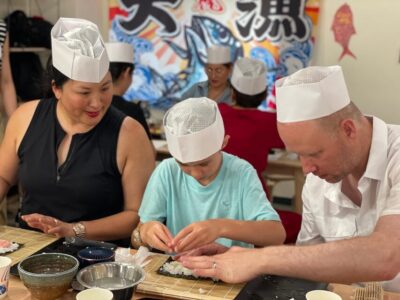 ★ 4.9Tsukiji Fish Market Sushi Making Class with Pro ChefFrom $63506 reviews
Browse the lists this tour appears in