
Ink and tea, side by side.
This one-hour sumi-e class happens in a relaxing green tea shop in Tokyo, where the goal is simple: make your own ink-wash piece with guidance you can actually follow. I like that the instructor starts with a clear demonstration, and I like that you leave with a physical souvenir you can use or display at home. The only real caution is that you’ll be wearing clothes that may get ink on them, so don’t dress like you’re going out for dinner.
You’ll also get a small-group feel (max 8), which matters when you’re learning something as hands-on as brushwork. The vibe is calm and practical, not performance-art fog. One possible drawback: this isn’t a long-form workshop, so your finished work reflects what you choose to focus on in the time you have.
In This Review
- Key things I’d circle before you book
- A quiet table for sumi-e and green tea
- What you make: coasters, a USB lamp shade, or a hanging kakejiku
- 1) Coasters course: 9 cm washi for your ink design
- 2) Lamp shade course: a USB-lit square
- 3) Hanging scroll course: kakejiku, 75×32 cm
- One theme decision you can actually feel
- How the 1-hour class runs, step by step
- First 10 minutes: intro and a demonstration
- Middle 40 minutes: your painting time
- Final 10 minutes: output check and instruction
- The teachers and the tea-room rhythm
- Price and value: what $105 buys you (and why it’s fair)
- What to bring (so ink doesn’t ruin your day)
- Who this experience suits best
- Where you’ll meet and what to plan around
- Tips to get the most from your brush time
- Should you book this sumi-e class?
- FAQ
- How long is the sumi-e experience?
- What is the meeting point?
- What courses are available to choose from?
- Is the instructor available in English?
- What is included in the price?
- What should I bring?
- Is it suitable for young children?
- What is the cancellation policy?
Key things I’d circle before you book
- Pick one theme for your design, then translate it into sumi-e in the time you have
- Choose your object: 9 cm washi coasters, a USB lamp shade, or a 75×32 cm kakejiku hanging scroll
- Small group (8 max) means more attention when your brush hits the paper
- Tea is part of it and the experience leans into the slow, relaxing rhythm of the shop
- Take-home keepsakes: you can bring your piece home, and it won’t be something you’ll see anywhere else
More ink on paper
- Tokyo: Calligraphy on Kanji Fan & Scroll with Drink★ 5.0 · 210 reviews
- Let’s experience calligraphy in YANAKA, Taito-ku, TOKYO !!★ 5.0 · 127 reviews
- Tokyo: Calligraphy Workshop & Original T-Shirt Creation★ 4.9 · 105 reviews
A quiet table for sumi-e and green tea
Sumi-e is the kind of art that makes you slow down. There’s no crowded studio energy, no big sales pitch—just black ink, water, and a brush doing what brushes do when you stop trying to control every detail. You’re in a green tea shop in Tokyo, and that setting helps your brain shift gears. Instead of rushing, you’re settling in.
What makes it interesting is the match between method and mood. Ink-wash painting has a Zen connection—bold strokes and careful spacing, but also room for variation. In a calm tea room, that feels natural. The class still teaches you technique, but it doesn’t treat perfection as the point.
I also like the fact that this experience is built around an end product you can keep. You’re not just watching or practicing scraps. You’re making something you can use as a coaster, light a corner with, or hang on a wall.
What you make: coasters, a USB lamp shade, or a hanging kakejiku
Before the brush even touches paper, you get to choose what you’ll create. You pick one of three course options, and that choice changes the whole feel of the class.
1) Coasters course: 9 cm washi for your ink design
You’ll draw on washi paper coasters (9 cm diameter). This option suits you if you want something compact and practical. It’s also easier to treat as a finished “mini artwork” because the surface is small and you can see your progress quickly.
2) Lamp shade course: a USB-lit square
For the lamp shade course, you create your design on a 10 cm square lamp shade that lights up via USB connection. This is a great pick if you like functional art. Your brushwork becomes something you can see in a different way once it’s backlit.





3) Hanging scroll course: kakejiku, 75×32 cm
The hanging kakejiku course gives you the biggest canvas: 75×32 cm washi paper in a traditional hanging format. If you like the idea of something more ceremonial—something meant to be displayed—this is the one. It also gives your strokes more visual space, so your theme choice matters even more.
One theme decision you can actually feel
Across all options, you choose one painting theme you want to draw. That matters because sumi-e isn’t about adding lots of detail; it’s about choosing what to suggest. Your theme becomes a shortcut for how to place your brushwork.
How the 1-hour class runs, step by step
This workshop is tight and well-paced. It’s only one hour, but it doesn’t feel rushed—because the structure is simple.
First 10 minutes: intro and a demonstration
The instructor begins with a self-introduction and then shows sumi-e in action. You’ll see how ink behaves, how water changes the tone, and what kind of stroke patterns the instructor expects. This part is more than show-and-tell. It’s your map for what to try when it’s your turn.
If you get the right first impression here, the rest of the class clicks faster. And in the feedback, people consistently highlight how strong the teachers are—so it’s worth paying close attention during the demo.
Middle 40 minutes: your painting time
Now it’s you and the brush. You’ll follow the guidance and work through your chosen theme on your chosen item (coaster, lamp shade, or kakejiku). This is the heart of the experience. You’re learning the balance between controlled strokes and the natural effects of ink-water mixture.
This is also when a small group helps. With a class capped at 8 participants, you’re less likely to feel stuck in silence. You can usually get quick direction if a stroke goes the opposite of what you intended.
Final 10 minutes: output check and instruction
In the last stretch, you review your output with the instructor and get final pointers. This is where you leave confident that what you made is finished as a keepsake, not just a half-done project.
And yes—you’ll take your work home as a special souvenir. That take-home element is a big part of why this class feels satisfying rather than purely educational.
The teachers and the tea-room rhythm
The best part of this experience, based on what people celebrated, is the teaching style. One review specifically mentions master Shigen, and the overall reaction is that the teachers are great—patient, clear, and encouraging.
The tea shop setting plays into that. Sumi-e can feel oddly meditative, and tea adds a grounding routine. One person even noted drinking a lot of tea, which matches the slow, relaxing tempo of a green tea space.
This is the kind of activity where the room matters as much as the instruction. If you’ve ever tried a creative class in a noisy setting, you know how quickly concentration evaporates. Here, it’s easier to focus on the brush and what it’s doing.
Price and value: what $105 buys you (and why it’s fair)
At $105 per person for a 1-hour class, the headline number can look a little high if you compare it to entry-level workshops. But when you break down what’s included, it starts to make more sense.
You get:
- painting class fees
- painting equipment
- tea
So you’re not hunting for materials or paying extra for ink tools. You’re using what the studio provides, and you’re working in a guided setting with a limited group size.
You also leave with a finished piece tailored to your theme—coaster, lamp shade, or hanging scroll. That turns the cost from a “class fee” into a “making fee” for a take-home artwork. If you love crafts that end with something useful or display-worthy, the value is stronger than typical one-time lessons.
In short: you’re paying for guidance, materials, and a relaxed cultural setting where you can create something tangible fast.
What to bring (so ink doesn’t ruin your day)
This class is hands-on, and the rules are honest: wear clothes you don’t mind getting inked. You’ll want something you can tolerate if a spot lands in the wrong place.
Practical move: dress in layers you can remove easily after. If you’re wearing something delicate, you’re rolling the dice.
One extra detail you should know: you’ll be asked to tell your birth of date. Plan to share it without scrambling.
And since your class is in a shop environment, think footwear-wise too. You’ll likely be sitting or leaning over your workspace, so comfortable shoes are smart.
Who this experience suits best
This is a great fit if you:
- want a cultural activity that doesn’t require prior art skills
- like small-group settings (max 8)
- want a take-home souvenir that feels personal
- enjoy calm, slow experiences with tea and instruction
It’s also a smart choice if you’re traveling with a partner or friends who might not all want the same intensity level of sightseeing. This gives everyone a shared activity, and the output is each person’s own.
It may not be the best fit if you:
- want a long workshop with lots of detailed techniques
- hate the idea of wearing clothes that could get inked
- are bringing kids under 5 (it isn’t suitable for children under 5)
Where you’ll meet and what to plan around
Meeting point is 4F building. That’s the key practical detail you should have ready when you arrive. For the rest, just remember: this is a short, focused block of time, so build your day around it.
Transportation isn’t included, so make sure you’ve got a plan to get there smoothly. If you’re in central Tokyo, that’s usually manageable with public transit, but the workshop itself won’t help with getting there.
Tips to get the most from your brush time
You’ll enjoy this more if you treat it like a guided practice rather than an art exam.
A few practical tips:
- Pick a theme you can express with a few strong suggestions. Sumi-e often works best when you stop chasing tiny details.
- Watch the instructor’s demonstration closely in those first 10 minutes. Your brushwork will make more sense when you understand the stroke logic.
- Don’t fight the ink-water behavior too hard. Part of sumi-e’s charm is that variation you didn’t fully micromanage.
- Keep your expectations simple. You’re making something meaningful in one hour, not creating a museum piece.
If you do that, the class tends to turn into a memorable souvenir moment—something you can point to later and say, I made that.
Should you book this sumi-e class?
I think you should book it if you want a calm Tokyo activity with real instruction and a take-home result. The small group size, the English-speaking instructor, and the three clear output options (coasters, USB lamp shade, or kakejiku) make it feel well structured for most visitors.
You might skip it if you’re uncomfortable with ink stains or you’re looking for a longer, deeper art course. The time is short by design. But for the price—where equipment and tea are included—and for the fact that you leave with your own ink piece, it’s a strong value for a one-hour creative break.
FAQ
How long is the sumi-e experience?
The experience lasts 1 hour.
What is the meeting point?
The meeting point is the 4F building.
What courses are available to choose from?
You can choose one of these: coasters (9 cm diameter on washi paper), a lamp shade (10 cm square, lights up via USB connection), or a kakejiku hanging scroll (75×32 cm made of washi paper).
Is the instructor available in English?
Yes, the instructor speaks English.
What is included in the price?
Painting class fees, painting equipment, and tea are included.
What should I bring?
Wear clothes you don’t mind getting dirty or inked. You may be asked to share your birth of date.
Is it suitable for young children?
It is not suitable for children under 5 years old.
What is the cancellation policy?
Free cancellation is available until 24 hours in advance for a full refund.
More Tour Reviews in Tokyo



Brush and Ink: More Calligraphy Hours

Fresh reviews from around Tokyo






Calligraphy Experiences, compared.
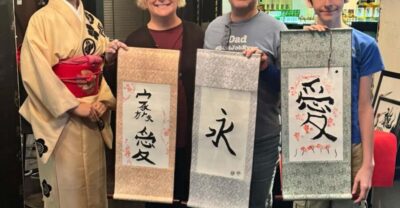 ★ 5.0Calligraphy on Kanji Fan & Scroll with DrinkFrom $53210 reviews
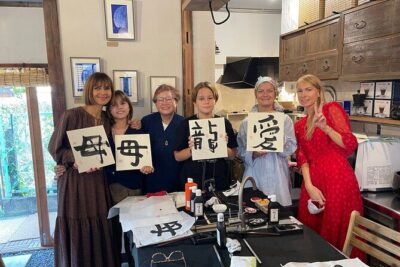 ★ 5.0Let’s experience calligraphy in YANAKA, Taito-ku, TOKYO !!From $75127 reviews
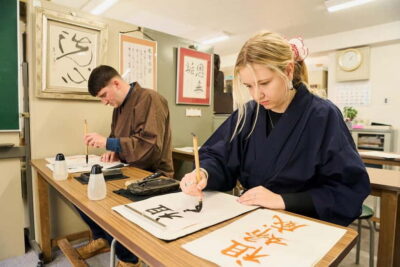 ★ 4.9Calligraphy Workshop & Original T-Shirt CreationFrom $30105 reviews
★ 5.0Calligraphy Workshop & Original T-Shirt CreationFrom $3380 reviews
★ 4.9Calligraphy Workshop & Original T-Shirt CreationFrom $30105 reviews
★ 5.0Calligraphy Workshop & Original T-Shirt CreationFrom $3380 reviews
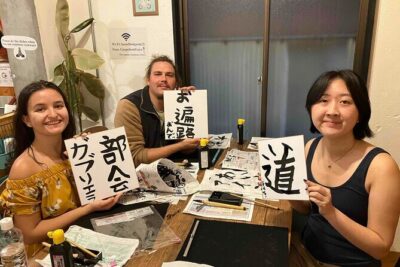 ★ 5.0Calligraphy Culture SHODO Experience in TokyoFrom $3366 reviews
 ★ 5.0Tokyo Asakusa:Calligraphy & Make T-shirt ActivityFrom $5862 reviews
 ★ 5.0Asakusa Calligraphy Workshop Craft Your Own Art in TokyoFrom $4054 reviews
 ★ 5.0Tokyo Japanese Calligraphy Experience with a Master ArtistFrom $9235 reviews
Browse the lists this tour appears in