
Reviewed · DINNER EXPERIENCES
Tsugaru shamisen performance over traditional dinner
Asakusa at dusk feels different. This small-group tour strings together temple-town walking and a Tsugaru-shamisen concert without forcing you to juggle extra reservations. You start around 5:30 pm, head through classic Asakusa sights, then finish the night with live music and dinner in a small restaurant setting.
What I like most is the pacing: you get a guided history walk through Asakusa, but it’s not the kind of crowd-chasing you see on big group tours. The second big win for me is that dinner is included with one welcome drink, so the evening stays simple.
One thing to consider: the dinner-and-show venue is small, so seating can feel tight. If you’re the type who really needs lots of personal space, this might be the only part that feels a bit “up close.”
In This Review
- Key highlights worth your attention
- Why a 5:30 pm Asakusa route makes sense
- Asakusa Culture Tourist Information Center: your quick orientation stop
- Kaminarimon and Nakamise: where the story becomes street life
- Senso-ji Temple: the stop that grounds the whole night
- The walk to dinner: short enough to feel doable
- The restaurant show: where Tsugaru shamisen gets personal
- Dinner + one welcome drink: simple, cultural, and timed well
- Price and value: what $218.91 is buying you
- Who this tour is best for
- Should you book this Asakusa shamisen dinner tour?
- FAQ
- What time does the tour start, and how long is it?
- Is dinner included, and what’s included with it?
- How long is the Tsugaru shamisen concert?
- How big is the group?
- Where do I meet the tour, and where does it end?
- Is hotel pickup included?
Key highlights worth your attention
- Small-group cap (up to 8 travelers) keeps the history walk and the dinner show easier to enjoy
- Asakusa Culture Tourist Information Center Observation Deck gives you a quick skyline view before you go temple-hopping
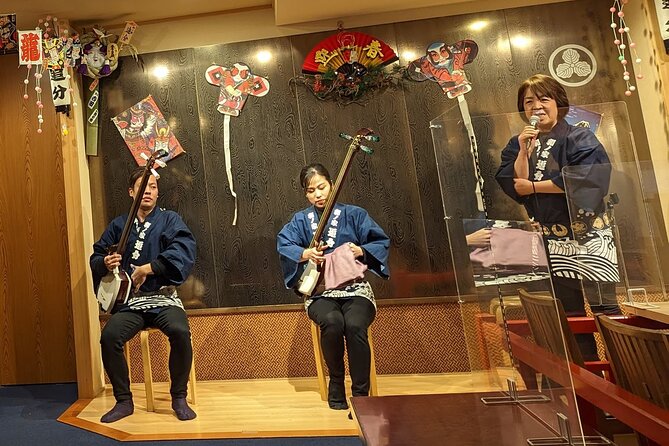
- A 40-minute live Tsugaru shamisen concert by award-winning performers
- Senso-ji and its gate sequence (Kaminarimon to Hozomon) helps you understand the layout fast
- Meeting the musicians after the show adds a human, personal touch
- Vegetarian-friendly handling based on past guests’ experiences
Why a 5:30 pm Asakusa route makes sense
This is a smart time-slot if your days are already packed. Starting at 5:30 pm lets you see Asakusa as it transitions. You’re still close to the big sights, but you’re not starting at the peak daytime surge.
You’re also not just getting one thing. The tour is built like a good evening plan: a short Asakusa history primer, iconic temple landmarks, then a live performance that’s tied directly to Japanese traditional music culture. The Tsugaru shamisen piece is the main event, and doing it right after dinner gives you a full “evening arc,” not a random add-on.
Another practical win: you’re moving as a group with a planned route, so you don’t have to keep stopping to figure out what’s next. The group stays small (up to 8 travelers), which also helps if you want to ask questions.
For value, the biggest reason this works is the all-in flow. You’re paying a single price that covers your dinner and your 40-minute concert, instead of piecing it together with separate tickets and reservations. At $218.91 per person, it’s not a budget option—but it’s also not just “a show ticket plus walking.” You’re buying the structure and the local guidance.
Asakusa Culture Tourist Information Center: your quick orientation stop
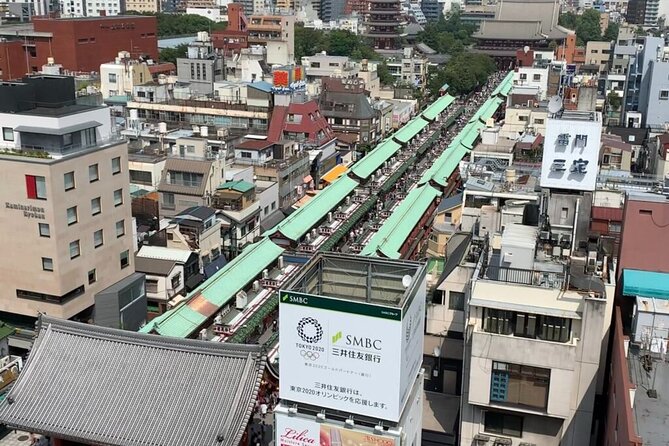
You begin at the Asakusa Culture Tourist Information Center. The standout here is the open terrace Observation Deck on the top floor, where you can get a view over the area before you head down into the historic core.
This kind of orientation stop is more useful than it sounds. Asakusa can feel like a maze once you’re among the shops and temple entrances. A quick look from above helps you later when you’re walking the route and spotting how the gates and streets connect.
The stop is short—about 15 minutes—and you don’t need any special ticketing beyond the free admission noted for the center. It’s also free, so you’re not spending time or money before the real sightseeing begins.
One small consideration: it’s an open terrace, so check the weather. This tour is marked as requiring good weather overall, and it’s the evening—so cooler or windy conditions can make the outdoor portions feel longer.
Kaminarimon and Nakamise: where the story becomes street life
Next you go to Kaminarimon (Thunder Gate), the famous entrance with the giant red lantern. It’s a quick stop—just around 5 minutes—but it’s a key checkpoint. Think of it as your visual “start line” for the Senso-ji area.
Then comes Nakamise Shopping Street, which runs toward Senso-ji. This is the part that surprises a lot of people. If you imagine temples as silent and solemn only, Nakamise is different: it’s lively in a street way, with shops and that everyday energy that makes Asakusa feel lived-in.
Another practical note: this tour doesn’t drag. You’re not being marched for hours through shopping. You’re using the street as a connector between landmarks, and the guide helps keep the context.
After Nakamise, you hit another “gate step” moment: Hozomon (Treasure-House Gate). This is the inner gate compared to Kaminarimon, and the route logic becomes clearer as you move inward. Hozomon has a two-story structure, and it leads you closer to the main temple grounds.
Why this sequencing matters: seeing these gates in order gives you a sense of how the space is designed. You’re not just snapping photos—you’re learning the layout at a pace you can handle.
Senso-ji Temple: the stop that grounds the whole night
The tour’s temple anchor is Senso-ji, Tokyo’s oldest temple and one of its most significant. You spend about 5 minutes here, which might sound brief—until you realize the point of this tour is the full evening package. It’s enough time to take in the main features, but it’s not trying to replicate a long standalone temple tour.
Senso-ji is also adjacent to the five-story pagoda. This matters because the pagoda is one of the visual “anchors” people remember even if they don’t know all the details. It’s part of why the area has that instantly recognizable skyline of temple silhouettes.
If you’re the type who likes to understand what you’re seeing (not just see it), the guide’s job is to connect the dots quickly. In past experiences, guides like Akiko and Yoko san have been singled out for bringing real clarity to the history and development of this old-town area and for pointing out how the religious complex functions as more than a single building.
A realistic tip: since this is the evening portion, be ready for shifting light and busier pockets of foot traffic near entrances. You’ll move as a group, so you won’t be stuck waiting forever, but the flow around Senso-ji can still be tighter than quieter backstreets.
The walk to dinner: short enough to feel doable
After the temple stops, the tour heads to the dinner-and-show restaurant. The route is described as about a mile of walking from the tourist center to where the evening show happens, give or take.
For most people, that’s manageable. But it’s not nothing, especially if you’re wearing shoes that aren’t great for evening strolling. I’d treat this as a light-to-moderate walking plan: one good walking pair of shoes is the difference between enjoying the evening and feeling slightly annoyed.
The good news is pacing. This is not a sweaty marathon. You’ve already toured temple entrances and streets, so your body has time to adjust. The guide keeps moving, but not at a pace that feels like a race.
The restaurant show: where Tsugaru shamisen gets personal
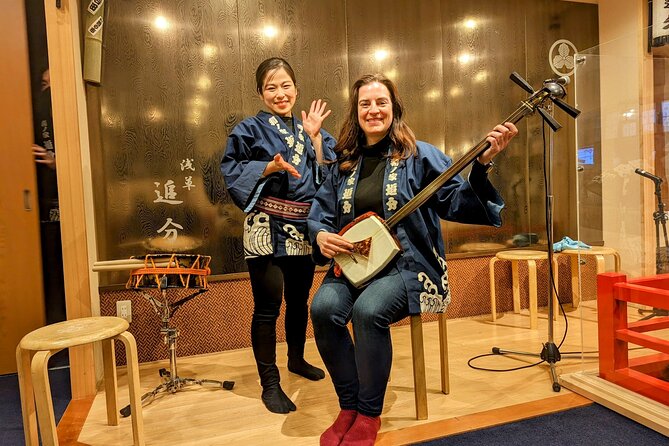
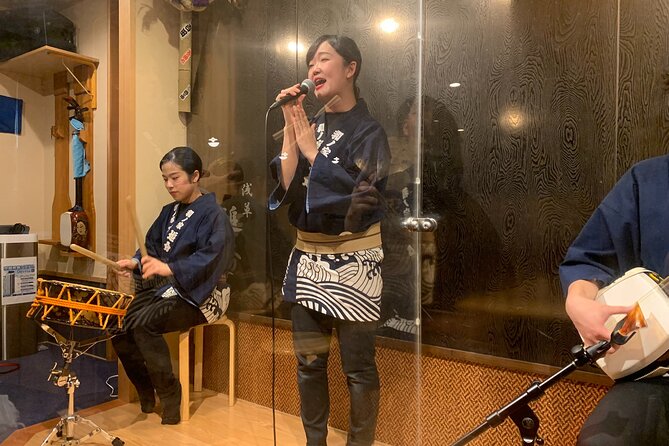
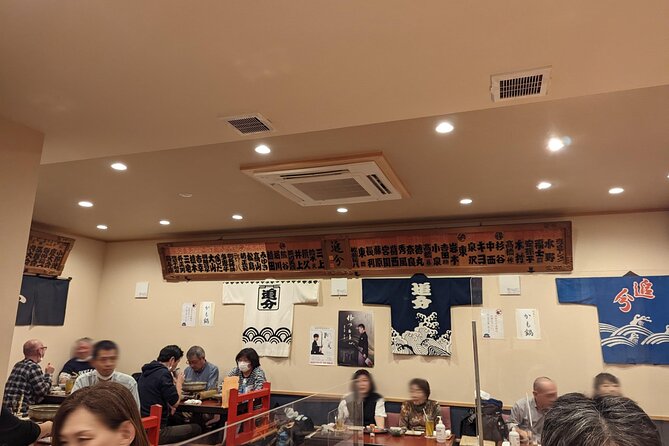
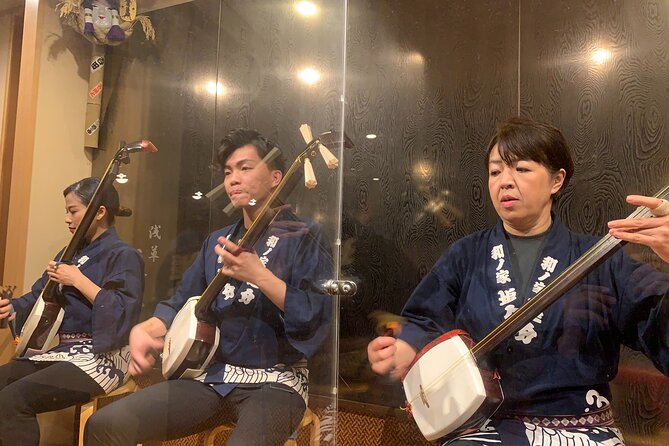
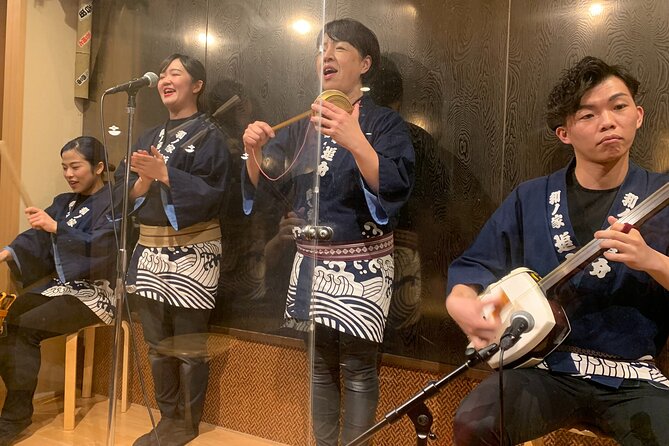
This is where the tour earns its name. The performance happens in a small Japanese restaurant with limited seating, and the show is presented close-up. You’re not in a big hall where sound just floats around. Instead, the musicians sit and play in a way that feels more conversational.
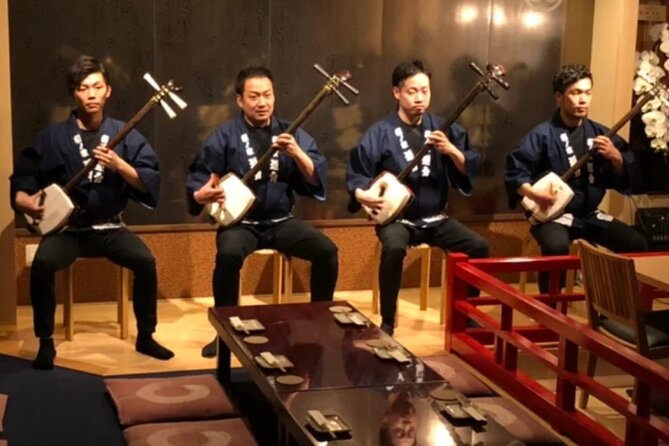
The performance length is 40 minutes. It’s listed as a live concert of Japan’s traditional musical instruments, with a focus on Tsugaru-shamisen, performed by award-winning performers.
Here’s what you should expect from a Tsugaru shamisen concert in this kind of setting: the tone and rhythm will feel more immediate because you’re closer. You’re also more likely to notice small performance details—how the music lands, how the dynamics shift—because there’s less distance swallowing the nuances.
An added bonus is the human part: you’ll meet the musicians after the show. That matters because traditional performances can feel like a “watch only” experience. Meeting the performers turns it into a short conversation with the people behind the music, even if it’s just a quick exchange.
From a comfort standpoint, remember the venue is small. If you’re sensitive to tight spacing or don’t like being seated near strangers, this is the part where you should set expectations.
Dinner + one welcome drink: simple, cultural, and timed well
Dinner is included, along with one welcome drink. Drinks beyond the welcome drink can be ordered separately, but they’re not included in the tour price.
What’s valuable here is timing. Dinner isn’t tacked on earlier in your day and then forgotten. It’s paired with the performance, so you’re finishing the evening in the same cultural setting, not bouncing between different locations.
About the food itself: based on past experiences, the meals have included a variety of Japanese staples, and there’s at least one clear proof point for dietary needs. One guest specifically noted that they are vegetarian, and the tour went out of its way to accommodate them—so you’re not just hoping for the best. That’s the kind of detail that matters when you’re booking a cultural dinner.
One practical note: because the concert and dinner happen in the same small space, the meal isn’t usually “slow dining with a menu browsing session.” Expect a smooth, scheduled flow.
Price and value: what $218.91 is buying you
Let’s talk value without spin. At $218.91 per person, this costs more than a basic temple walk plus a separate concert ticket. You’re paying for three main things:
- Guided Asakusa route that strings together the key landmarks efficiently
- Dinner included so you’re not paying extra for the evening meal
- A live Tsugaru shamisen show in an intimate setting, for 40 minutes, plus time to meet performers
The small-group size (max 8) helps justify the structure. A tour like this works better when the guide can keep the group together and when the dinner space doesn’t turn into chaos.
If you compare it to the alternative—buying temple tickets (often none), finding dinner seats, booking the performance separately, and then trying to match the timing—this package saves you effort. That’s especially true if you only have one evening in Asakusa.
The only real “value warning” is expectation management. It’s not a long, day-long exploration. It’s around 4 hours, and the schedule is built around specific stops and an evening concert. If what you want is hours of free roaming shopping streets, you might feel slightly guided rather than free.
Who this tour is best for
This works best if you like a mix of structure and culture, and you don’t want the hassle of planning multiple reservations.
You’ll likely enjoy it if:
- You want a small-group look at Asakusa and don’t want to fight big crowds
- You’re interested in Japanese traditional music and want a close-up Tsugaru shamisen experience
- You’d rather have one price that includes dinner than hunt for a compatible evening plan
- You appreciate guides who connect the “what” of famous places with the “why” (like Akiko and Yoko san have been praised for)
It might be less ideal if:
- Tight restaurant seating will bother you
- You hate walking and want a no-walking evening (this includes about a mile of walking)
Should you book this Asakusa shamisen dinner tour?
I’d book it if you want one great evening that feels authentically Japanese, without turning your night into a checklist. The pairing of Senso-ji area sightseeing and a 40-minute Tsugaru shamisen show in a small restaurant setting is a strong combo, and the fact that dinner is included (with a welcome drink) makes the plan easier than doing it piece by piece.
I’d think twice if you’re very sensitive to crowded or tight spaces inside a restaurant. Also, since the tour is marked as weather-dependent, pick a night when you’re comfortable with outdoor parts and the possibility of a reschedule.
If you’re traveling with a limited schedule and you want quality over quantity, this is the kind of tour that turns one evening into a complete story—from the gates of Senso-ji to the sound of the shamisen.
FAQ
What time does the tour start, and how long is it?
The tour starts at 5:30 pm and runs for about 4 hours (approx.).
Is dinner included, and what’s included with it?
Yes. Dinner is included with one welcome drink. Additional drinks can be ordered separately, but they are not included.
How long is the Tsugaru shamisen concert?
The live concert is 40 minutes.
How big is the group?
This activity has a maximum of 8 travelers.
Where do I meet the tour, and where does it end?
You meet at the Asakusa Culture Tourist Information Center. The tour ends at 5-chōme-37-7 Asakusa, at the restaurant where the dinner and performance take place.
Is hotel pickup included?
No. Hotel pickup and dropoff are not included. The tour is near public transportation.
Dinner Experiences, compared.
 ★ 5.0Tokyo Bar Hopping Tour in Shinjuku (All-You-Can-Drink + Dinner)From $1063,587 reviews
 ★ 4.8Sumo Show and Dining ExperienceFrom $792,742 reviews
 ★ 4.6Sumida River: Japanese Traditional Yakatabune Dinner CruiseFrom $103779 reviews
 ★ 4.5Tokyo Bay Yakatabune Dinner/Day Cruise with Japan Show and DrinksFrom $65473 reviews
 ★ 4.9Shinjuku Bar Hopping with All-You-Can-Drink & DinnerFrom $108440 reviews
Tokyo Dinner Cruise & Tradition Show & Drinks & Tokyo TowerFrom $95315 reviews
★ 4.9Shinjuku Bar Hopping with All-You-Can-Drink & DinnerFrom $108440 reviews
Tokyo Dinner Cruise & Tradition Show & Drinks & Tokyo TowerFrom $95315 reviews
 ★ 4.7Tokyo Bay: Traditional Japanese Yakatabune Dinner CruiseFrom $108243 reviews
 ★ 4.5Authentic Geisha Performance with Dinner in TokyoFrom $239101 reviews
Browse the lists this tour appears in