
Autumn in Nikko hits different on a road trip. This day tour strings together three very “Japan” moments in one long loop: Irohazaka Slope (48 curves), Kegon Falls (with the paid elevator to the base viewing area), and the Watarase Keikoku Railway through a gorge-like valley. It’s built for fall colors and for seeing a lot without you having to plan trains, transfers, or ticket counters.
I like that the day is not just bus-to-waterfall. You get a proper waterfall viewpoint with the elevator, then time at Lake Chuzenji for calmer pacing and big autumn reflections. I also like that the tour handles key logistics with a mobile ticket, an air-conditioned vehicle, and an English & Korean speaking guide (group size tops out at 49).
One drawback to plan around: this is a long day, and the timing can feel padded depending on traffic and how long you’re at each stop. If you’re sensitive to motion, the winding Irohazaka drive is also something to take seriously.
In This Review
- Key points to notice before you go
- Nikko in one long day: why this route can work (and for whom)
- Irohazaka Slope and the Initial D vibe: 48 curves and motion sense
- Kegon Falls with the paid elevator: where the view really improves
- Lake Chuzenji at 1,269 meters: reflections plus a calmer rhythm
- Watarase Keikoku Railway from Mato to Godo: the slow train break
- How the day pacing can feel: long bus hours, timing swings, and lunch gaps
- Price and value math: what your $161 is really paying for
- Best-fit autumn day trip: who should book and who should skip
- Should you book this Nikko autumn day trip?
- FAQ
- How long is the Nikko autumn tour?
- Is the Kegon Falls elevator included?
- What train ride does the tour include?
- Do I need to bring lunch?
- Is there anything optional on this tour?
- What about motion sickness on Irohazaka Slope?
- What’s the cancellation window?
Key points to notice before you go
- Irohazaka Slope is famous for a reason: 48 named curves that connect central Nikko to Oku-Nikko
- The Kegon Falls elevator is the best-value add-on for a closer view at the lower platform
- Lake Chuzenji is your breathing space between big sights, with high-altitude autumn air
- Watarase Keikoku Railway is a slow change of pace on a former copper-transport line
- Bring snacks since meals aren’t included and lunch may not be a sit-down break
- Expect schedule shifts because the vehicle time limit and real-world traffic/weather can alter pacing
Nikko in one long day: why this route can work (and for whom)
This tour is designed for people who want autumn highlights outside Tokyo without doing the day’s planning. You’ll start in the Tokyo area, then spend about 11 to 12 hours on the move. The tradeoff is time: you’re on a bus for a lot of the day, with fewer chances to wander at your own rhythm.
The value comes from what’s included. It’s not just a sightseeing list. You get transport in an air-conditioned vehicle, a guide, and paid entry points that are usually the biggest “decision headaches” on your own—especially the Kegon Falls elevator ticket and the Watarase Keikoku Railway ticket. At $161 for the full day, that usually pencils out better than paying everything separately, as long as the pacing fits your style.
This tour tends to suit you best if:
- you love autumn scenery and want a focused day around it
- you’re okay with a bus-and-train itinerary
- you want a guided plan that reduces friction
It may feel less satisfying if you prefer lots of free time, or if you’re the type who gets annoyed when plans shift due to weather, daylight, or traffic (because they do).
Irohazaka Slope and the Initial D vibe: 48 curves and motion sense
The morning begins at Irohazaka Slope, the Nikko road known for its 48 winding curves, each tied to a character from the old Japanese Iroha syllabary. It connects central Nikko to the Oku-Nikko area, so you’re not just taking a scenic detour—you’re moving along a historically important mountain route.
Here’s what’s useful to know. This isn’t a stop where you park and hike for views. You’ll be seeing the slope from the vehicle as you go, with the autumn colors wrapping the road. That makes it a great early-day photo opportunity, but also a place where timing matters: you’ll want the colors to be at their best, and you’ll want to avoid getting stuck if the bus has to pause.
If motion sickness is a problem for you, take it seriously. The route has many turns, and you’re right there in the action. The tour recommends taking medication in advance if you’re prone to it. I’d treat that as a real tip, not a casual note.
My practical suggestion: bring water and a light layer. Mountain drives can feel cool even in autumn, and a little comfort makes the curves easier to handle.
Kegon Falls with the paid elevator: where the view really improves
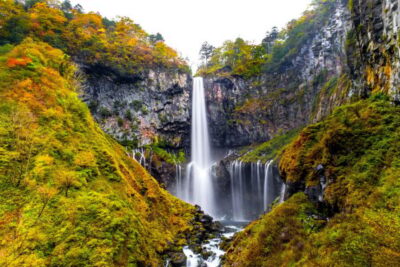
Kegon Falls is one of Japan’s best-known waterfalls, and the tour makes a smart choice by including the paid viewing elevator. The waterfall drops about 97 meters from Lake Chuzenji. You can view it from different areas, and the elevator option is the one that gives you the closer, more dramatic base-level perspective.
How the elevator works: you descend roughly 100 meters in about one minute to the lower viewing platform near the base of the falls. If you’re trying to decide what’s worth paying for on your own, this is the kind of upgrade that actually changes your experience. From the lower platform, you’re not just watching water fall—you’re standing closer to the force and the mist.
You’ll also have time around the area after the waterfall. The tour schedule includes a break near Lake Chuzenji, and that’s a good pairing. Kegon is intense, and then Lake Chuzenji gives you calmer scenery and room to move at an easier pace.
One thing to watch: daylight. If you arrive later, the sun may not hit the falls as nicely, and the lower areas can feel darker depending on conditions. You don’t control the day’s timing, but you can control your expectations: earlier is better for that warm autumn look, while later tends to mean moodier, less colorful views.
Also keep in mind the simple reality: you’re traveling, and sometimes crowds and schedules compress how long you can linger. Plan for shorter-than-ideal sightseeing spurts even if the schedule looks generous.
Lake Chuzenji at 1,269 meters: reflections plus a calmer rhythm
After Kegon Falls, you head to Lake Chuzenji, located at an altitude of 1,269 meters. It was formed by a volcanic eruption more than 20,000 years ago, and the area is known for a refreshing alpine climate—so yes, even in autumn, the air can feel crisp.
This is the part I like most when a day tour gets too intense. Lake Chuzenji works as a reset. You’re not wrestling with steps up and down a cliff. Instead, you get space to stroll around the shoreline and look for reflections. In autumn, the combination of mountains + still water can create a mirror effect that feels almost unfair—like the scenery is doing extra work just to impress you.
The tour gives you about 50 minutes here. That’s enough time to walk a bit and take photos without turning it into a full-on hike. If you’re the type who needs longer stretches, you might wish for more, but as a mid-day pause it’s well placed.
Tip: bring snacks because meals aren’t included. A quick bite by the lake (even something simple) makes the break feel more like a planned rest and less like a waiting gap.
Watarase Keikoku Railway from Mato to Godo: the slow train break
In the afternoon, the tone shifts again when you reach Mato Station and board the Watarase Keikoku Railway. The ride is the “slow” highlight: the train travels through a scenic valley and makes the scenery feel closer because you’re moving gradually, not racing past it from a bus window.
This line used to exist for practicality. It was originally built to transport copper from the Ashio Mine. Today, that same infrastructure serves tourism, which is why it’s so appealing for an autumn day—because the ride isn’t just about moving you from one point to another. It’s about giving you time to watch the hills and countryside change as the train curves through the gorge.
You’ll ride from Mato and disembark at Godo Station. The schedule lists about 40 minutes for the train segment. In real terms, that should mean you can settle in, find a window seat if possible, and take the ride as the experience rather than treating it like a transfer.
One practical note: train timing can feel a bit variable when a group is managing several connections. If the day’s schedule slips, the train ride might still be short, and then the scenery has to carry the whole moment. That’s fine if you’re in “scenery mood,” less ideal if you came for a long rail adventure.
How the day pacing can feel: long bus hours, timing swings, and lunch gaps
This is where you need the clearest expectations. The overall plan covers a lot of ground and includes several active stops, but you’ll still spend a big chunk of the day on the vehicle. Even with air-conditioning, long seating on a full day can feel tight, especially if the coach is smaller than you expected. If you hate being stuck in one position for hours, pack for comfort: small pillow if you use one, water, and something to keep you warm.
The schedule also depends on traffic and weather, and there’s a legal constraint in Japan that limits how long the vehicle can operate—up to 10 hours—with the guide adjusting the route accordingly. Translation: the order and timing of stops can shift, and your day may run slightly different than the “ideal” itinerary.
Then there’s food. Meals aren’t included, and lunch time may not be set up as a sit-down restaurant break. The tour specifically recommends bringing snacks or a light lunch to enjoy at attractions. I strongly agree. It’s one of the easiest ways to prevent that bored, cranky feeling that builds when your energy drops and the day’s still moving.
Finally, consider that some stops may run longer or shorter depending on site conditions. That can affect everything from how long you’re at the falls to how much time you actually spend around Lake Chuzenji.
Price and value math: what your $161 is really paying for
At $161, you’re paying for a full day structure: guide support, transport, and specific tickets. If you try to build the day yourself, your biggest costs tend to be the transit time plus the time you lose figuring out ticketing and routes. This tour removes that friction.
Here’s the value breakdown in plain terms:
- Transport in an air-conditioned vehicle for a long round trip from the Tokyo area
- English & Korean speaking guide to keep the day moving with less guesswork
- Kegon Falls elevator ticket included, which is the main paid upgrade tied to the most satisfying viewing experience
- Watarase Keikoku Railway ticket included, covering a rail segment that otherwise takes planning
- Mobile ticket that reduces the hassle of paper pickups
The only real “value risk” is your fit. If you feel the day drags due to bus time or daylight, then the included tickets won’t fully rescue it. If you’re happy with a controlled one-day plan and you care about getting the best viewing option at Kegon, this price starts to look fair.
Best-fit autumn day trip: who should book and who should skip
I’d book this if:
- you want autumn in Nikko but don’t want the stress of arranging transport and tickets
- you’re excited by the combination of road views (Irohazaka), a major waterfall (Kegon), lake reflections (Chuzenji), and a rail ride (Watarase)
- you like guided pacing even if it means you can’t linger for hours
I’d skip or at least reconsider if:
- you’re sensitive to winding roads and long coach time (take the motion sickness warning seriously)
- you prefer flexible schedules and long free time at each stop
- you’re planning around a very specific sunlight moment and can’t handle a schedule shift
One extra note: there’s an optional Akechidaira Ropeway to an observation deck for 1,000 yen round-trip. Since it’s optional, you can decide based on how your day is running. If your timing feels tight, skipping it might be the smarter move.
Should you book this Nikko autumn day trip?
Book it if your goal is a clean, ticket-supported autumn highlight day: Kegon Falls with the elevator and the Watarase Keikoku Railway are the two big reasons it feels worth it. The Irohazaka Slope add-on is a strong “Nikko identity” moment, especially in fall color.
Don’t book it if your happiness depends on long unstructured time, or if you strongly prefer to control your own schedule minute-by-minute. This is a managed day. That’s great when you want convenience. It’s less great when you want freedom.
If you do book, go prepared: snacks in your bag, a layer for mountain air, and motion sickness care if you need it. With those in place, you’ll get the best version of what this day is built to deliver.
FAQ
How long is the Nikko autumn tour?
It runs about 11 to 12 hours.
Is the Kegon Falls elevator included?
Yes. The tour includes the Kegon Waterfall elevator ticket to the paid viewing area.
What train ride does the tour include?
You ride the Watarase Keikoku Railway from Mato Station and get off at Godo Station. The railway ticket is included.
Do I need to bring lunch?
Meals are not included. It’s recommended to bring snacks or a light lunch since lunch time isn’t listed as provided.
Is there anything optional on this tour?
Yes. You may take the Akechidaira Ropeway to an observation deck for 1,000 yen round-trip.
What about motion sickness on Irohazaka Slope?
The road has many winding turns, and the tour recommends taking motion sickness medication in advance if you’re prone to it.
What’s the cancellation window?
You can cancel for a full refund up to 24 hours before the experience starts. Free cancellation is available until that cutoff.
Nikko Day Trips, compared.
 ★ 4.6Nikko: Kegon Falls, Lake Chuzenji & Toshogu TempleFrom $891,577 reviews
 ★ 4.5Nikko Toshogu Shrine and Kegon Waterfall TourFrom $841,266 reviews
 ★ 5.0Nikko Full-Day Private Tour with Government-Licensed GuideFrom $155259 reviews
 ★ 4.9From Tokyo: Nikko World Heritage Site Private Full-Day TripFrom $483243 reviews
 ★ 4.3Nikko: Edo Wonderland Edomura Cultural Theme Park TicketFrom $35205 reviews
From Tokyo: Nikko World Heritage Sight Full Day Private TourFrom $362127 reviews
★ 4.3Nikko: Edo Wonderland Edomura Cultural Theme Park TicketFrom $35205 reviews
From Tokyo: Nikko World Heritage Sight Full Day Private TourFrom $362127 reviews
 ★ 4.9Nikko – Beautiful Full-Day Personal and Private TourFrom $364119 reviews
 ★ 5.0Chartered Private Tour – Tokyo to Nikko, Toshogu, Edo WonderlandFrom $1,286105 reviews
Browse the lists this tour appears in