
Tokyo feels fast on a go-kart. What makes this one work is the small group size (up to 4) and the fact that you’re not stuck figuring routes—your guide keeps the ride moving while you focus on driving and photos. My other favorite piece is the photo package, so you get a printed memory without chasing angles yourself. One big catch: you must bring the right paperwork, and the requirement for a hard-copy IDP can ruin your day if you’re even slightly off.
I like that the tour is short enough to fit into a busy Tokyo schedule (about 1 hour 15 minutes), yet it still strings together major areas: Shibuya Crossing, Harajuku, Omotesando Hills, and Shinjuku. If you go at night, the city lights and the overall vibe can feel extra good, and several people specifically recommend evening starts.
Finally, the route is built for fun and adrenaline, not a calm sightseeing crawl. You’ll be on a kart on public streets with traffic rules in play, plus you’ll get safety instructions before you ride—so it’s best for you if you’re comfortable following directions fast.
In This Review
- Key things that make this go-kart tour worth it
- Why the Shibuya to Shinjuku route feels like Tokyo’s best shortcut
- IDP rules: the part that can make or break your booking
- Your karts and safety briefing: adrenaline with rules attached
- The ride plan: Shibuya Crossing, Shinjuku, Harajuku Station, Omotesando Hills
- Shibuya Crossing: your first big Tokyo hit
- Shinjuku: where the city feels larger than life
- Harajuku Station: quick culture pulse
- Omotesando Hills: smoother pace, style streets
- Back to Shibuya Crossing: the highlight replay effect
- Night riding and the Tokyo-light advantage
- Cost and value: what $105.42 really buys you
- Photo shooting and optional costumes: easy souvenirs, lower stress
- What to bring so your day stays smooth
- Is this tour for you?
- Should you book this premium Shibuya-to-Shinjuku go-kart tour?
- FAQ
- Do I need an International Driving Permit to drive on this tour?
- Are digital or online copies of the IDP valid?
- Are 1968 Vienna Convention permits or online-acquired permits accepted?
- If my license is from certain European countries, do I need a Japanese translation?
- What is the maximum group size?
- Where is the meeting point in Shibuya?
- What stops are included on the route?
- What’s included in the price, and is an action camera extra?
- What happens if the weather is poor or you need to cancel?
Key things that make this go-kart tour worth it
- Up to 4 people means you spend more time riding and less time waiting around.
- Guided route through the icons: Shibuya Crossing, Shinjuku, Harajuku Station, Omotesando Hills.
- Street-legal, custom-built karts with a safety briefing before you start.
- Included photo keepsake with a printed photo shot during the tour.
- Evening can be a highlight based on people’s experience with night sessions and city lights.
- IDP is mandatory (hard copy, 1949 Geneva Convention) and it’s strict.
Why the Shibuya to Shinjuku route feels like Tokyo’s best shortcut
A lot of Tokyo tours try to do everything. This one takes a simpler approach: go where the action is, then move on before you get tired. You start in Shibuya, then work your way through the corridor of neighborhoods that most people want to see—Harajuku and Omotesando for style streets, then Shinjuku for the big city energy, with Shibuya Crossing as the emotional highlight.
What you’re really buying is time and momentum. In about 1 hour 15 minutes, you’ll experience multiple “wow” moments that usually take way longer by train plus walking plus detours. The guide keeps you on track, so you’re not spending your limited sightseeing hours staring at your phone.
The route also makes practical sense for first-timers. Even if you don’t know the city well, Shibuya, Harajuku, Omotesando, and Shinjuku give you a fast read on Tokyo’s different moods—without needing a day-long plan.
IDP rules: the part that can make or break your booking
Here’s the deal in plain terms: this tour requires a hard-copy International Driving Permit issued under the 1949 Geneva Convention (paper booklet form). Online copies are not accepted.
If you’re planning to drive, do these checks before you leave home:
- Make sure your IDP is specifically under the 1949 Geneva Convention.
- Bring the physical paper booklet. Digital versions are not valid.
- Don’t rely on a “maybe” workaround. The operator follows Japanese safety and legal requirements.
The rules are also very specific about what is not recognized:
- 1968 Vienna Convention, IDA, IAA, or other permits acquired online are not recognized.
- Some countries’ permits are not allowed for driving in Japan. You’ll need to check that your country issues the 1949 Geneva Convention IDP.
If your license is from France, Switzerland, Taiwan, Germany, Monaco, or Belgium, you need a Japanese translation of your local license, and the physical copy can be obtained from JAF (Japan Automobile Federation).
One more practical note: multiple reviews mention being turned away for documentation problems. That doesn’t mean the tour is “hard.” It means you should treat the IDP step like a key requirement, not a formality.
Your karts and safety briefing: adrenaline with rules attached
This is a “drive” experience, not just a ride in a vehicle. You’ll get settled into a custom-built, street-legal go-kart, and before you set off you’ll receive a thorough safety briefing and driving instructions from the guide.
That matters more than it sounds. Tokyo driving can feel intense even when you’re walking. On a kart, you need clear signals and simple rules so everyone stays predictable for the group. The guides are there to handle that—giving you directions and keeping you safe while you enjoy the ride.
From people’s feedback, guides like Reece, Rakesh, Brandon, and Juan were often described as friendly, attentive, and focused on safety. The consistent theme: you’re not thrown in and left to figure it out. You’ll learn how to operate the kart properly, understand turn behavior, and get guided through stop-and-go moments.
Also, the tour is designed for small group pacing. With a maximum of 4 travelers, it’s easier for the guide to manage spacing and make sure everyone can have time where they feel in control.
The ride plan: Shibuya Crossing, Shinjuku, Harajuku Station, Omotesando Hills
You’ll pass through several iconic spots, and the itinerary order is built to keep the experience feeling “connected.” Here’s what each main stop is likely to feel like, and what to watch for.
Shibuya Crossing: your first big Tokyo hit
You kick off at Shibuya Crossing, which is the perfect starter because it immediately tells you what you signed up for: motion, lights, and big-city scale. Expect a high-energy moment where the guide sets the tone and you get your first taste of steering in a busy-feeling area.
Possible drawback: Shibuya Crossing is intense in mood even when you’re not walking. On a kart, that can be a lot at the start of your session. If you’re nervous at first, lean on the guide’s instructions and let your hands do what you practiced in the briefing.
Shinjuku: where the city feels larger than life
Next you head into Shinjuku, which changes the feel fast. This is where Tokyo can look bigger and more layered, with streets that hint at the dense grid underneath the neon glow.
What I like about this stop: it usually feels like you’re seeing Tokyo from a more “street level” view than a train window or a slow sidewalk walk. You’re moving through it, not just above it.
Consideration: Shinjuku can also be a sensory overload if you’re easily overwhelmed by sound and signage. The good news is you’re driving, so your attention has a job—focus on following the guide and your timing at turns.
Harajuku Station: quick culture pulse
You’ll then pass by Harajuku Station, an area people associate with fashion-forward streets and a faster rhythm. On a kart, the change is noticeable because the streets around these zones tend to feel more immediate and close-up.
If you like Tokyo’s youth style and side streets, this stop helps you “read” that vibe without needing hours of walking and guessing which street to turn into.
Omotesando Hills: smoother pace, style streets
Your route includes Omotesando Hills, which tends to feel a little more polished. Even when you’re moving at speed, this area can read as sleek and designed.
The practical value here: it gives you a contrast to the heavier energy of Shibuya and Shinjuku. You get a Tokyo that looks less like a crowd and more like a planned corridor—great if you want photos that look clean and modern.
Back to Shibuya Crossing: the highlight replay effect
The tour includes Shibuya Crossing again. That repetition isn’t a mistake—it often works because the second time you’re more comfortable driving, so the crossing becomes less about nerves and more about enjoying the scale.
If you’re the type who wants the biggest moment to land when you’re ready, this “again” is a win.
Night riding and the Tokyo-light advantage
Several people recommend the nighttime version of this experience. They mention things like city lights looking great and the sensory experience—lights plus wind and sound—feeling more intense in a fun way.
One review specifically said their night session had no traffic, which can make the driving feel easier and more relaxed. I wouldn’t promise “no traffic” for every night, but it does suggest that evening departures may often deliver a smoother ride.
If you’re choosing between day and night, I’d lean toward night if:
- You want Tokyo visuals that feel cinematic.
- You prefer streets lit up over daytime heat and glare.
- You’re okay with a little extra darkness while you focus on instructions.
Cost and value: what $105.42 really buys you
At $105.42 per person, you’re paying for more than “just a kart.” The included items matter:
- Go kart and fuel
- Guide
- Photo shooting plus a hard-copy printed photo
- Locker
- Bottled water
So the value isn’t only the thrill. It’s the whole package of setup + guidance + city driving + a souvenir photo you can hold in your hands.
If you’ve ever tried to “DIY” a Tokyo activity like this, you know how many pieces you need to line up: correct equipment rules, a route, a safety plan, and someone to manage group movement. Here, your guide handles that structure, and the karts come ready.
Add-on costs exist too. An action camera is listed at ¥3,500 per person, so if you want more footage, budget for it. For many people, the included photo is enough, especially since you’re concentrating on driving.
Photo shooting and optional costumes: easy souvenirs, lower stress
This tour includes photo shooting, plus you get a printed photo afterward. That is a surprisingly big quality-of-life point. You’re driving and watching the road. You don’t have to guess where to stop for a good shot or time your own photos while seated on a kart.
People also describe feeling like they were photographed more like celebrities than random tourists. The takeaway for you: plan on letting the crew handle the camera work.
There’s also an optional costume element. You can choose to dress up in a fun costume before you ride. That’s not just silly branding—it can make the photos look more memorable and it helps break any first-minute awkwardness when you’re about to drive through iconic streets.
What to bring so your day stays smooth
Because this is a driving experience, your checklist should be short and serious:
- Your hard-copy IDP (1949 Geneva Convention) in the required paper format
- Your local driver’s license (since your IDP ties to it)
- Any required Japanese translation if your license falls under the listed countries
- Your confirmation details (a mobile ticket is used)
Also, bring the mindset that safety comes first. You’ll get instructions, and the guide will set the rhythm, but you still need to drive thoughtfully and follow signals.
If you want extra video, consider whether you’ll pay for the action camera add-on. If you just want great memories, the included photo package is built to do that job.
Is this tour for you?
You’ll likely love this experience if:
- You want a high-impact, short Tokyo activity (about 1 hour 15 minutes).
- You prefer a small group experience (maximum of 4).
- You’re excited by driving a street-legal go-kart through famous areas.
- You want a guide doing route and safety management, plus photos handled for you.
You might skip it if:
- You don’t have the required hard-copy 1949 Geneva Convention IDP (or you’re not sure).
- You dislike following structured rules and safety guidance closely.
- You’re hoping for a long, calm sightseeing day. This is motion and adrenaline, not a slow tour.
Should you book this premium Shibuya-to-Shinjuku go-kart tour?
If you have the right IDP paperwork and you want a fun, time-efficient Tokyo hit, I’d say yes, book it. The small group setup, the guide-led route through Shibuya Crossing plus Harajuku/Omotesando/Shinjuku, and the included photo keepsake are exactly the kind of “don’t waste time” value that works well in Tokyo.
My only hesitation comes down to the legal requirement. If your IDP situation is unclear, fix it before you buy anything. When the paperwork is correct, this kind of driving experience turns Tokyo from something you see into something you feel.
FAQ
Do I need an International Driving Permit to drive on this tour?
Yes. Drivers are required to present a hard-copy International Driving Permit issued under the 1949 Geneva Convention (or other approved licenses in accordance with Japanese law).
Are digital or online copies of the IDP valid?
No. Online copies or digital copies of permits are not valid. You must bring the printed, physical booklet.
Are 1968 Vienna Convention permits or online-acquired permits accepted?
No. Permits under the 1968 Vienna Convention, IDA, IAA, or other permits acquired online are not recognized for driving on this tour.
If my license is from certain European countries, do I need a Japanese translation?
Yes, if your license is from France, Switzerland, Taiwan, Germany, Monaco, or Belgium, you need a Japanese translation. The physical copy can be obtained from JAF.
What is the maximum group size?
This activity has a maximum of 4 travelers.
Where is the meeting point in Shibuya?
The tour starts at Monkey Adventure Kart Shibuya Shop 2, 2nd Namiki Building, 1st floor, 3-chōme-17-3 Shibuya, Tokyo 150-0002, Japan.
What stops are included on the route?
The ride includes Shibuya Crossing, Shinjuku, Harajuku Station, Omotesando Hills, and then Shibuya Crossing again.
What’s included in the price, and is an action camera extra?
Included: the go-kart, fuel, guide, photo shooting, locker, bottled water, and a hard-copy printed photo. An action camera is available as an add-on for ¥3,500 per person.
What happens if the weather is poor or you need to cancel?
This experience requires good weather. If it’s canceled due to poor weather, you’ll be offered a different date or a full refund. You can cancel up to 24 hours in advance for a full refund.
Shibuya Tours, compared.
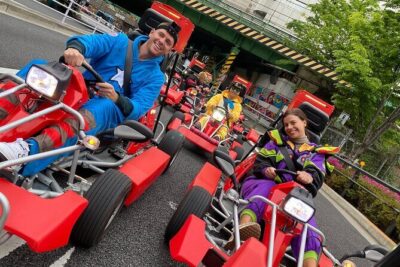 ★ 5.0Official Street Go-Kart in ShibuyaFrom $763,435 reviews
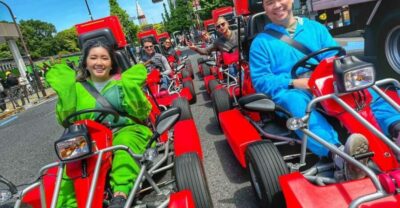 ★ 4.9Street Kart Experience in ShibuyaFrom $741,484 reviews
 ★ 5.0Shibuya Meltdown Nightlife Tour: All-You-Can-Drink Bar HoppingFrom $1061,058 reviews
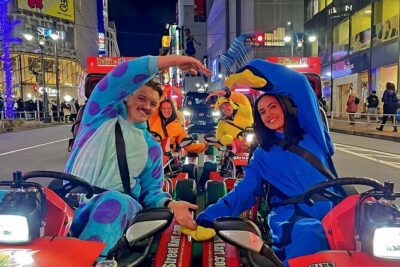 ★ 5.0Shibuya Official Street Go-Kart in Shibuya AnnexFrom $69972 reviews
 ★ 5.0Shibuya Food Tour (13 dishes and 4 Eateries)From $77770 reviews
 ★ 5.0Best of Shibuya Food TourFrom $217612 reviews
 ★ 4.8Shibuya Highlights Walking TourFrom $19601 reviews
 ★ 4.7Premium Go-Kart Tour with Tower & Shibuya CrossingFrom $116528 reviews
Browse the lists this tour appears in